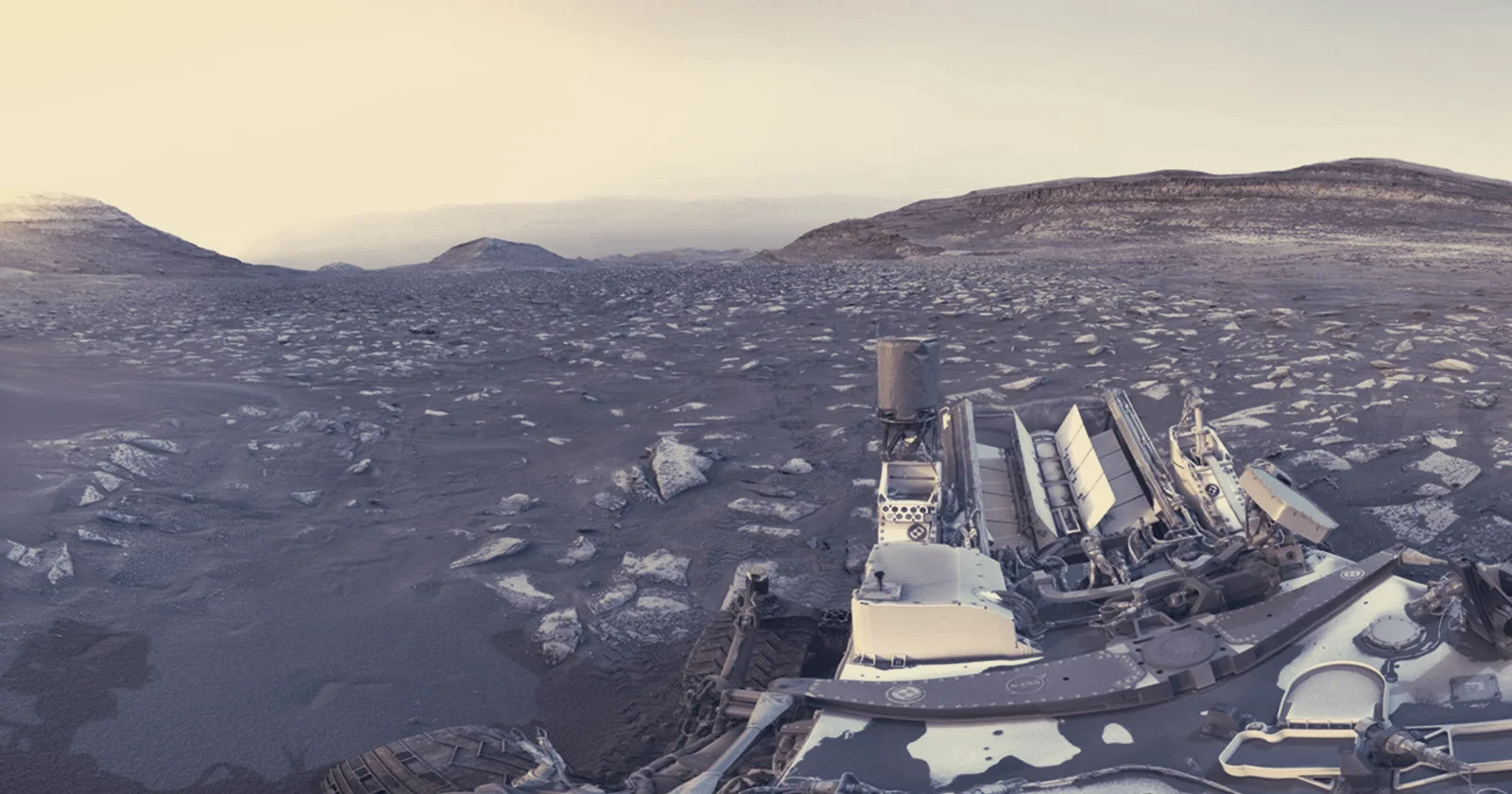
Curiosity confirmed it remains active beyond 5,000 Martian days by returning a merged morning-and-afternoon panorama from a sand ridge the team calls Chocolatal. The rover captured two black-and-white navigation-camera mosaics, one on Aug. 30, 2026 at 9:56 a.m. local Mars time, corresponding to the mission's 5,000th sol, and a second on Sep. 2, 2026 at 5:39 p.m. local Mars time, on sol 5,003. Engineers sent the files back to Earth and combined them into a single “postcard” image.
Color was added after return as an artistic interpretation, with blue assigned to the morning views and yellow to the afternoon shots, illustrating how lighting changes over the course of a Martian day. The merged scene follows a format used by the team in earlier outreach mosaics, including a similar postcard produced in November 2021.
The composite frames the rover's deck in the foreground, making hardware visible such as its can-shaped UHF antenna, used to relay data to orbiting spacecraft, and the finned Multi-Mission Radioisotope Thermoelectric Generator, Curiosity's nuclear power source. The rover's wheel tracks stretch away from the vehicle and the image looks down toward the floor of Gale Crater.
Curiosity is currently working in the lower foothills of Mount Sharp, the 3-mile-tall, or 5-kilometre-tall, mountain that rises from Gale Crater. In the panorama the crater rim is barely perceptible on the horizon, reinforcing that the rover is parked on the mountain's flank while continuing to collect visual and contextual data for the mission team.
The rover was built by NASA's Jet Propulsion Laboratory, which Caltech manages in Pasadena, California, and JPL leads the mission on behalf of NASA's Science Mission Directorate as part of the agency's Mars Exploration Program. The merged panorama adds to the archive of long-duration imagery that documents Curiosity's position and environment as it proceeds through its extended mission on Mount Sharp.