
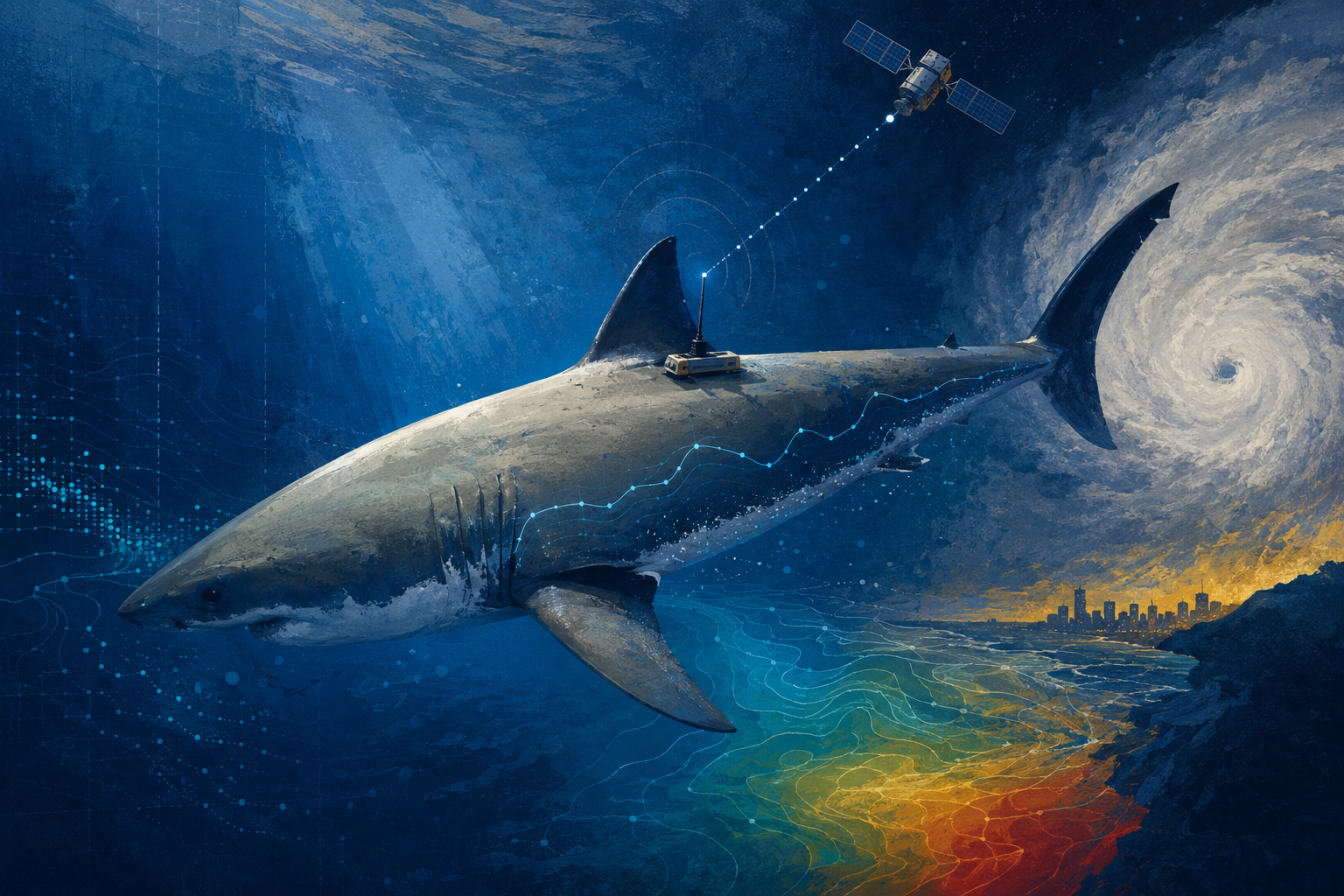
Researchers at the University of Delaware are testing whether sharks can become mobile ocean-data collectors,using small electronic tags to gather information that could help scientists predict the intensity of hurricanes approaching the US East Coast.
The project uses CTD tags,small electronic devices that measure electrical conductivity,a metric closely related to salinity,along with ocean temperature and depth as tagged sharks swim and dive.
The measurements can then be used to inform oceanographic,atmospheric and climate models.
“Animal-borne sensors have been used successfully by oceanographers for years,particularly on elephant seals in polar regions where scientific observations are scarce,” said Aaron Carlisle,principal investigator and a professor in the university’s School of Marine Science and Policy.
According to Carlisle,sharks present another opportunity because they are abundant,widely distributed and easier to access than many protected marine mammals.
Shark tagging has traditionally focused on tracking where the animals travel and identifying the habitats they use. The University of Delaware project instead aims to use their movements to collect measurements relevant to hurricane research.
Sharks Could Measure the Ocean Heat That Fuels Hurricanes
Researchers are selecting shark species capable of gathering useful measurements while surfacing frequently enough for their tags to transmit information to satellites.
Previous analyses identified shortfin mako sharks,blue sharks,smooth hammerheads and juvenile great white sharks as strong candidates for the research in the North Atlantic.
“We are really most interested in the heat content of the top layer of the ocean,which is known as the mixed layer,” Carlisle said.
“This is the part of the water column that really drives hurricane intensity,warmer mixed layer equals stronger hurricane,as it holds the heat that feeds hurricanes.”
Tagging begins in early May,when highly migratory shark species move closer to the coast from their winter habitats farther into the Atlantic.
Researchers travel between 50 and 65 kilometres offshore aboard a research vessel,deploy baited lines and typically wait two to three hours for a shark to take the bait.
“The tags are attached to the dorsal fin. Then every time the shark fins (swims) at the surface,the tag can communicate and transmit data to the orbiting network of satellite receivers,” Carlisle said.
The tagging process usually takes less than five minutes and is conducted under institutional animal care oversight. Materials used to attach the tags are designed to corrode and eventually fall off.
Researchers also conduct health checks before releasing the sharks because stress or harm could alter their natural behaviour and potentially affect the resulting data.
From Shark Tracking to Hurricane Forecasting
Caroline Wiernicki,a University of Delaware doctoral candidate in marine science,contrasted the project with the dramatic depiction of sharks in popular culture.
“It’s more like Bob from Accounting,clocking in with the day’s temperature profiles before he heads back out,” Wiernicki said.
If successful,the project could provide additional information for forecasting how powerful hurricanes may become as they approach the US East Coast.
Wiernicki said the measurements could give communities from North Carolina to Massachusetts more reliable information and help strengthen coastal resilience.
Carlisle said the research could also change how people perceive sharks.
“They are amazing animals perfectly adapted to the ocean,and we can learn a huge amount from them. If we can show that sharks can help people,it’s a win-win situation.”