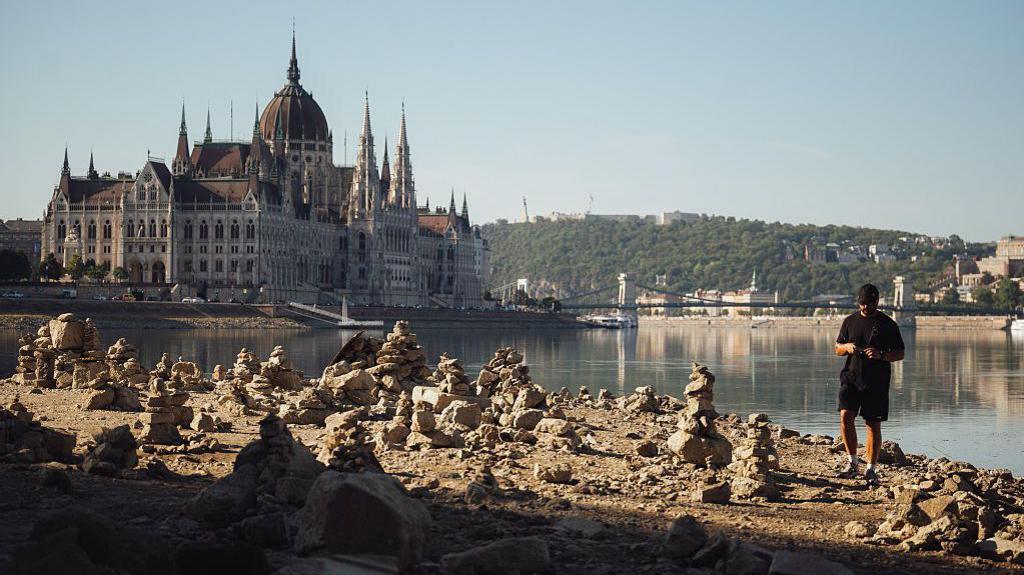
Hungary faces a potential energy crisis as its only nuclear plant prepares to stop operations, after water in the Danube fell to levels that prevent the reactor's cooling intakes from drawing river water. Prime Minister Péter Magyar said the Soviet-era Paks facility will be forced to halt entirely for the first time, and he warned supply could become "critical" from Monday as temperatures remain around 37C for a week.
Magyar called on citizens to curb high-consumption activities between 17:00 and 22:00, including charging electric vehicles and running air conditioning, and said rotating cuts to supply could be introduced if voluntary savings are insufficient. The government will draw up a list of electricity and water users whose consumption could be limited to protect the national grid.
The shutdown at Paks comes amid a broader Danube crisis that is disrupting energy and transport across the basin. In Romania, one of the two 706-megawatt reactors at the Cernavoda plant was taken offline earlier in the week, the reactor that supplies about 20% of the country's electricity. State-owned Nuclearelectrica said it was working to avoid closing the second unit, but if that reactor also stops, Romania would temporarily lose all nuclear generation.
River flow measurements underline the severity. Romania's National Institute of Hydrology says the July average flow where the Danube enters the country is 4,700 cubic metres per second, yet on Wednesday it had fallen to about a third of that, recorded at 1,600cm per second, and the institute expected a further drop to 1,500cm per second by Tuesday. The Danube stretches 2,857km, crossing 19 countries from the Upper basin in Germany to the branches of the delta that reach the Black Sea.
Low water has exposed wrecks and revealed unexpected finds. A sunken Hungarian cargo ship surfaced in Croatia, a German World War Two river flotilla hulk reappeared in Serbia, and a resident in Ruse, Bulgaria discovered mammoth remains on the river bed. Commercial navigation has stalled in parts of Bulgaria, and the Viking Ullur cruise ship ran aground near Vidin, forcing border police to evacuate 186 passengers after the vessel could not dock and supplies ran low.
Hydrologists point to a combination of sustained high temperatures and deficient spring rainfall. Serbian hydrologist Dejan Vladiković said low flows affect not only the Danube but also the Sava and Tisa tributaries, and that current levels are the lowest for 50 to 60 years, with no expected improvement before mid-September. Forecasts put temperatures in Serbia as high as 38C on Friday, locally reaching 40C, and night-time readings in Belgrade up to 26C.
European climate monitoring emphasises the broader context, with the Copernicus climate service noting the continent is warming about twice as fast as the global average, intensifying heatwaves, stressing water resources and increasing wildfire risk. Forecasters say fire-prone conditions may spread into central Europe, while recent blazes in France and Spain prompted hundreds of thousands of evacuations. For now the immediate test is keeping power and cooling systems running, with authorities balancing emergency measures and attempts to avoid wider nuclear outages.