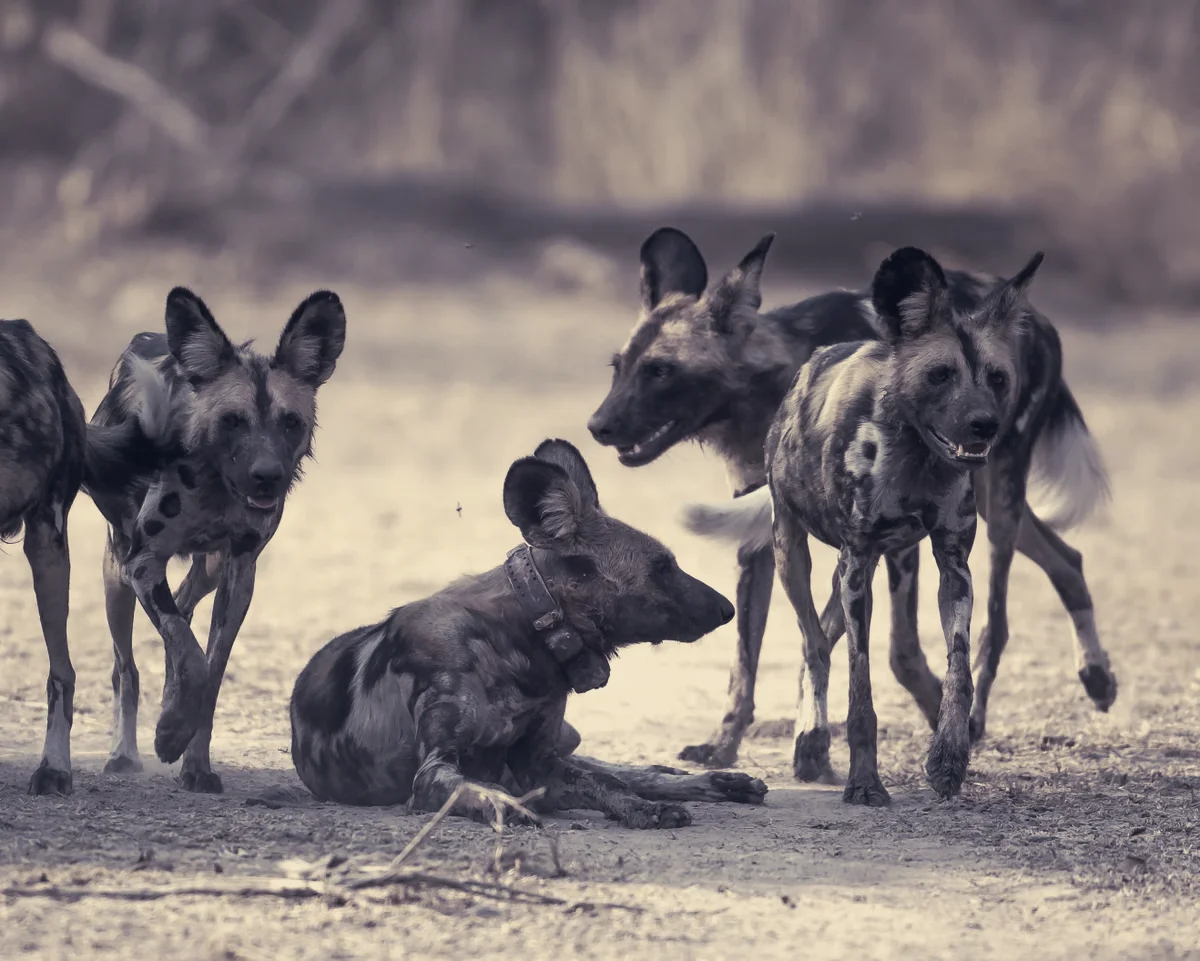
Landscape links that allow large mammals to move between strongholds remain, but they are fragile, researchers say, after three young African wild dogs travelled more than 2,500 miles across Zambia to establish a new range. The eight-month dispersal began in Kafue national park in the west and ended in the Luangwa valley in the east, and constitutes the longest single recorded journey by any mammal on the continent.
The Story in Pictures
Scientists fitted animals with GPS collars to monitor 19 groups of African wild dogs and record dispersal routes. The three brothers covered a point-to-point distance of 340 miles, a separate record, while their total odyssey measured 2,500 miles, or 4,100 km. The study that reports these movements appears in the journal Ecology. Researchers contrasted this successful dispersal with one made by related sisters, two of whom probably died after becoming entangled in snares.
The brothers and sisters encountered each other two months after setting out, meeting for a single day in Zambia’s copper-belt mining region before separating. Related individuals do not form new packs, so young wild dogs must travel to meet unrelated potential mates. The previous long-distance record was 2,418 miles, recorded for African wild dogs moving between Loliondo in northern Tanzania’s Ngorongoro district and Tsavo West national park in southern Kenya in 2012.
The continent retains some functional connectivity, but the journey exposed the dangers animals face outside protected areas. Habitat loss, falling numbers of natural prey, snares used by bushmeat hunters and conflict with people are listed among the biggest threats to African wild dogs. Only about 6,600 adults remain, spread across 39 distinct populations, and the species is classed as endangered on the IUCN Red List.
Researchers say the brothers’ movement underscores the conservation value of maintaining linked landscapes rather than relying solely on fenced parks. Dr Matt Becker of the Zambian Carnivore Programme says the dogs demonstrate that connectivity still works and that policy should focus on protecting and strengthening those links. Dr Nyambe Nyambe, director of the Kavango-Zambezi transfrontier area secretariat, argues that conserving and improving cross-boundary connections across national parks, community lands and states will allow species such as wild dogs to persist.
The record dispersal provides concrete evidence for planners and governments that long-distance movement remains possible, but it also highlights the lethal obstacles animals confront while doing the essential work of finding mates and new territories.