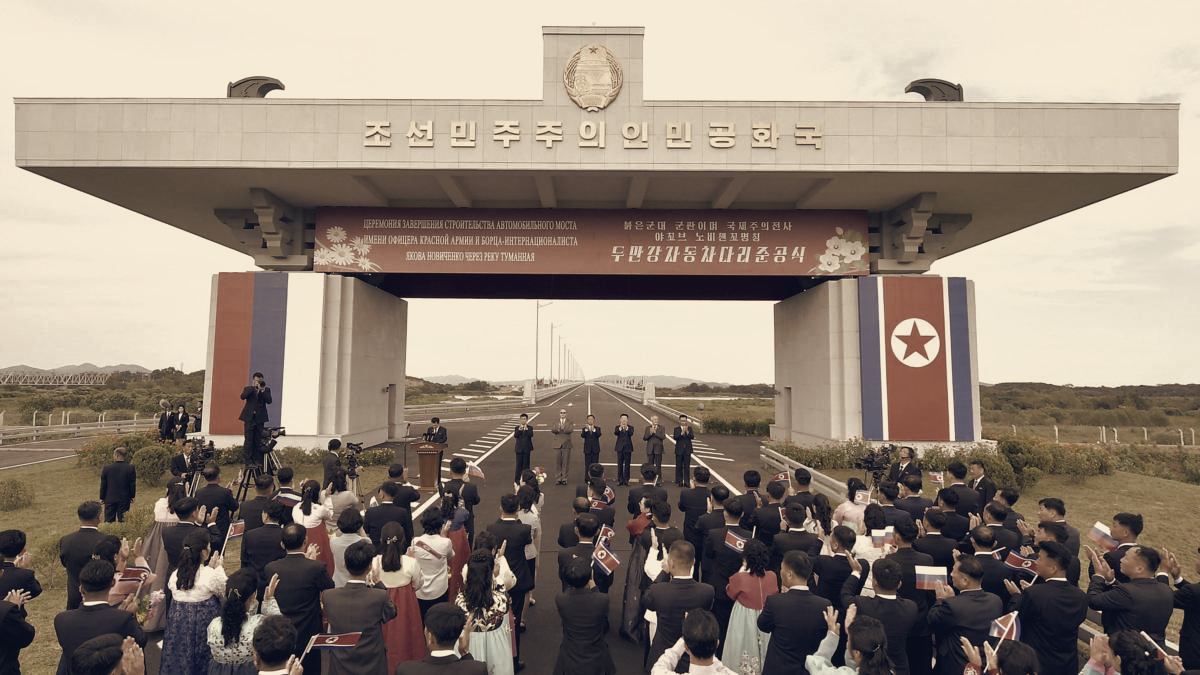

The opening of the first road bridge linking Russia and North Korea changes how goods and people will cross the two countries' shared border, allowing daily vehicle and passenger traffic between the border cities of Rason and Khasan.
North Korean state media said the crossing will be used for "personnel exchanges, tourism and trade," while Russian officials presented the structure as a symbol of closer ties. Russian Prime Minister Mikhail Mishustin called the bridge a "new symbol of friendship," and North Korea's Prime Minister Pak Thae Song described the opening as a "historical event." Russian state news agency TASS gives the crossing capacity as up to 300 vehicles and 2,323 people per day.
Ukrainian open-source investigators Truth Hounds warned the bridge is intended "primarily to establish a covert military logistics corridor" to support Russia in its war in Ukraine. Analysts and intelligence estimates cited in official statements point to existing military and material flows between the two states: one South Korean spy agency estimates North Korea has already transferred $7 to 14 billion worth of rockets, missiles and artillery shells by sea, and it assesses about 11,000 North Korean troops are actively fighting with Russian forces in Ukraine.
Satellite imagery published in May showed the roughly one-kilometre span alongside new access roads, a border checkpoint and parking and support facilities. Until now, road traffic relied on ad hoc arrangements that placed wooden planks on a rail bridge. The Russian government says the new bridge will be used initially to move cargo and will open to passenger traffic later this year.
Construction began in 2025 following an agreement reached during President Vladimir Putin's 2024 visit to Pyongyang that produced a strategic partnership treaty, and the crossing was finished in 495 days after delays. The road is expected to facilitate not only trade and tourism for Russian visitors who began travelling to North Korea in 2024, but also the movement of labourers; a South Korean estimate places about 10,000 North Koreans at Russian construction sites and logging camps, even though UN rules prohibit using North Korean labourers.
Victor Cha of the Center for Strategic and International Studies said the pace of work reflects rising trade volumes and is "spurred largely by North Korea's provision of troops, weapons, munitions, and labourers for Putin's war in Ukraine." Russian officials plan to prioritise freight at first, then open the link to passengers, a sequence that will be watched closely by regional analysts for its effects on military logistics and economic ties.