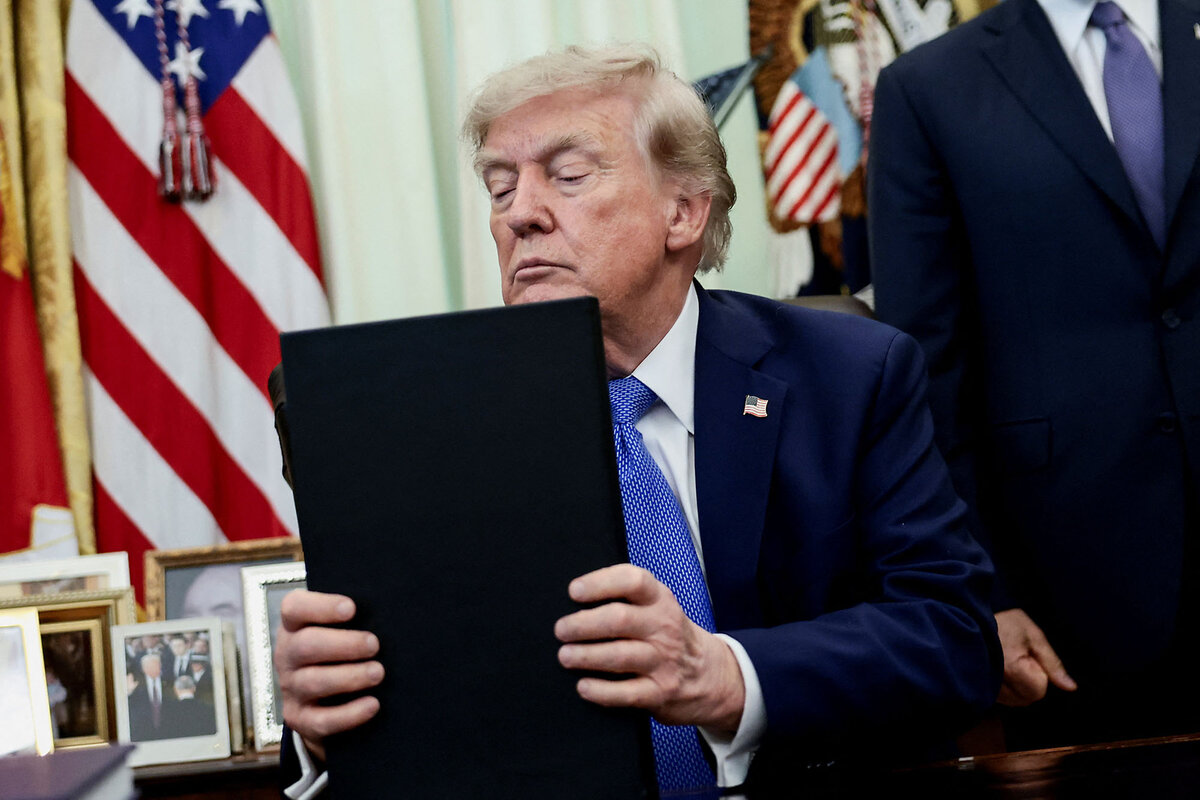
US President Donald Trump has signed two executive orders aimed at restricting birth tourism and limiting automatic birthright citizenship for certain groups.
The measures mark a renewed effort by his administration to narrow access to US citizenship after the Supreme Court rejected his first attempt in June.
Birthright citizenship generally grants US citizenship to people born on American soil, with limited exceptions. Birth tourism refers to foreign nationals travelling to the United States specifically to give birth so their child acquires citizenship.
Trump signed the two executive orders on Thursday.
The first expands the categories of non-citizens whose children would not automatically qualify for birthright citizenship.
Under the order, babies born in the US to two non-citizen parents would be excluded from automatic citizenship if one parent is a member of a foreign terrorist group, works for a foreign government, has attempted to obtain citizenship through fraudulent means, or lives in a US territory where federal law does not grant citizenship.
Some of those categories were already excluded under existing rules.
Colleen Putzel-Kavanaugh, an associate policy analyst at the Migration Policy Institute, said the provision involving membership of a foreign terrorist group could raise questions over how membership would be determined and who would carry the burden of proof.
The second executive order directs the Departments of State and Homeland Security to strengthen regulations and enforcement against birth tourism.
Travelling to the US specifically for the purpose of giving birth is already illegal.
According to the order, operators in the birth tourism industry use misleading advertising to attract foreign nationals by promising citizenship, access to public benefits and short-term accommodation.
The principle of birthright citizenship, known legally as jus soli or "right of the soil," is enshrined in the 14th Amendment to the US Constitution.
The amendment was originally intended to grant citizenship to American-born formerly enslaved people following the Civil War.
Under current law, nearly everyone born in the United States receives citizenship regardless of their parents' immigration status, with limited exceptions.
Those exceptions include children born to foreign diplomats, children of enemy soldiers during a hostile occupation, and people born in certain unincorporated US territories where citizenship has not been granted by federal law.
People born in Puerto Rico, Guam and the US Virgin Islands receive automatic citizenship, while those born in American Samoa are classified as non-citizen nationals.
Trump said on Thursday that "hundreds of thousands" of babies had been born through birth tourism in the US, but did not provide evidence or specify the period covered by the figure.
There are no official government figures specifically tracking women who enter the US on tourist visas to give birth.
According to the Centers for Disease Control and Prevention, just over 9,500 babies were born to foreign women in the US in 2024 based on births registered to mothers with foreign addresses.
The country recorded about 3.7 million births in total that year, meaning those births represented roughly 0.25% of the total.
The Migration Policy Institute estimates that between 20,000 and 26,000 babies are born in the US each year as a result of birth tourism, equivalent to around 0.5% to 0.7% of annual births.
The institute cautioned that determining exact figures is difficult because birth tourism depends on a person's intent when entering the country.
The Trump administration previously argued before the Supreme Court that unrestricted birthright citizenship had allowed the birth tourism industry to grow.
Solicitor General D. John Sauer argued that the system had created "a whole generation of American citizens abroad with no meaningful ties to the United States."
Chief Justice John Roberts rejected that interpretation during proceedings, saying: "Well, it's a new world. It's the same Constitution."
More than 30 countries grant largely unrestricted birthright citizenship, including Brazil, Argentina and Mexico.
The United States and Canada are the only countries classified as developed economies by the International Monetary Fund that maintain mostly unrestricted birthright citizenship, while countries including the United Kingdom and Australia use modified systems tied to the citizenship or residency status of a parent.