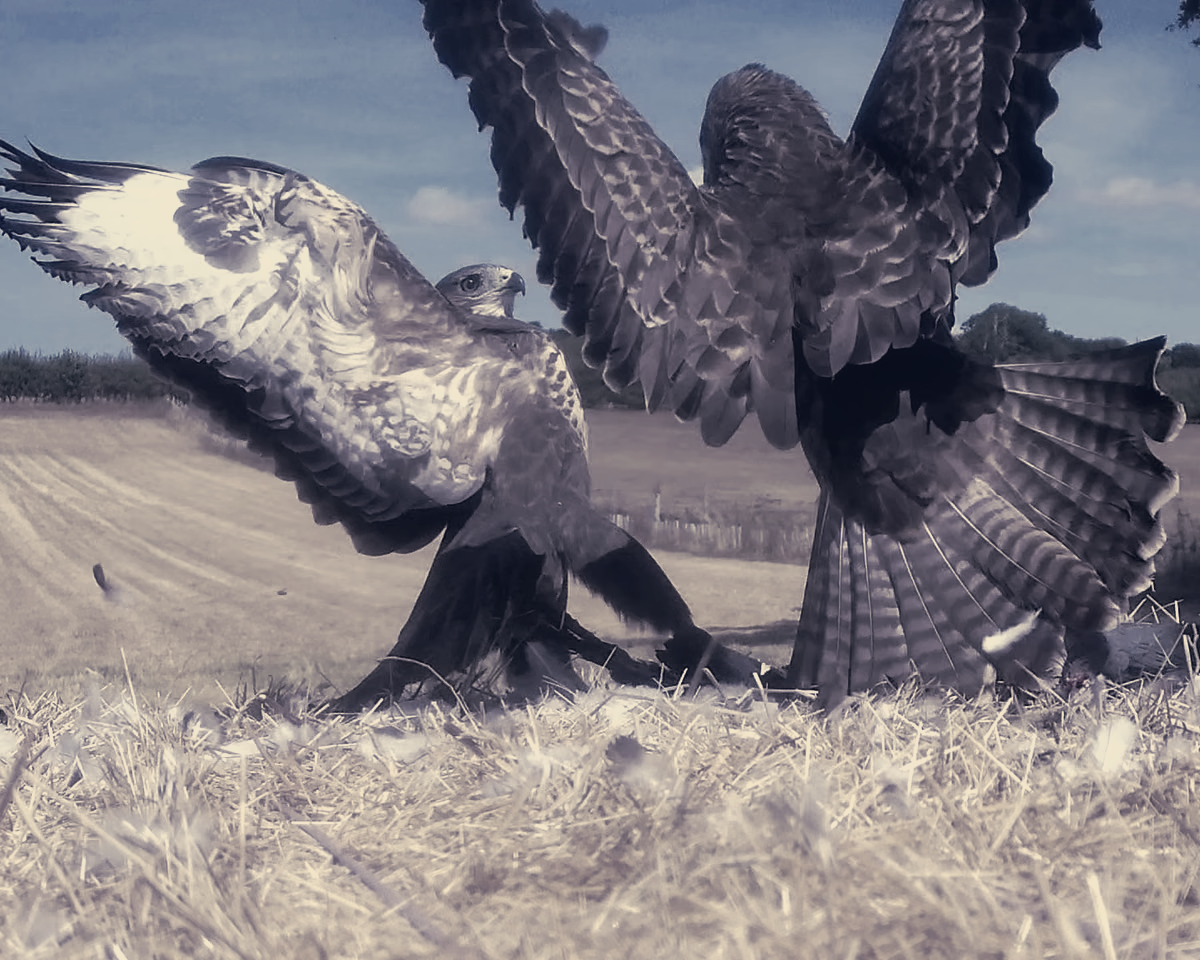
The farm’s next generation of buzzards will have to secure food without the easy pickings provided by recently cleared hay bales. Trail-camera footage from a bale on the yard captures two juvenile buzzards squabbling over a pigeon that an adult had recovered after forcing a peregrine to drop its prey.
The Story in Pictures
The film records a familiar sequence for anyone who has watched growing raptors: one young bird claims the pigeon, turns away from its challenger and spreads its wings to shield the meal in a behaviour known as mantling. The other bird prowls, slips a leg under the sibling’s protective wing and is rebuked with a sharp screech. Persisting, it at last provokes an aggressive response and both birds tumble off the bale in a moment of chaotic balance, followed by a high-pitched call from off-camera.
The scrape at the bale is set against a wider picture on the farm. There are three breeding pairs of buzzards, each nesting in a different wood, and the species alternates between soaring on thermals and loafing in the canopy. Despite a history of persecution and the mid-20th century myxomatosis outbreak that depleted their favoured rabbit prey, buzzards endured and in recent years have increased across the landscape.
Other yard life is tracking a harsher arithmetic. A late brood of twelve mallard ducklings has thinned to eight as nights pass, a reminder that the summer’s reproductive surplus still faces steep mortality before independence.
The trail-cam sequence combines natural-history observation with a domestic, almost comic intimacy: the gestures and noises of the young birds read to the eye like sibling rivalry, and the camera’s quiet vantage exposes the messy realities of feeding and hierarchy. With the bales gone the juveniles must now learn to secure prey without the concentrated, vulnerable food source that briefly brought them together.
What happens next on that farm will be decided by how quickly these young buzzards adapt to hunting for themselves and by the continuing availability of prey in the fields and woods around their nests.