
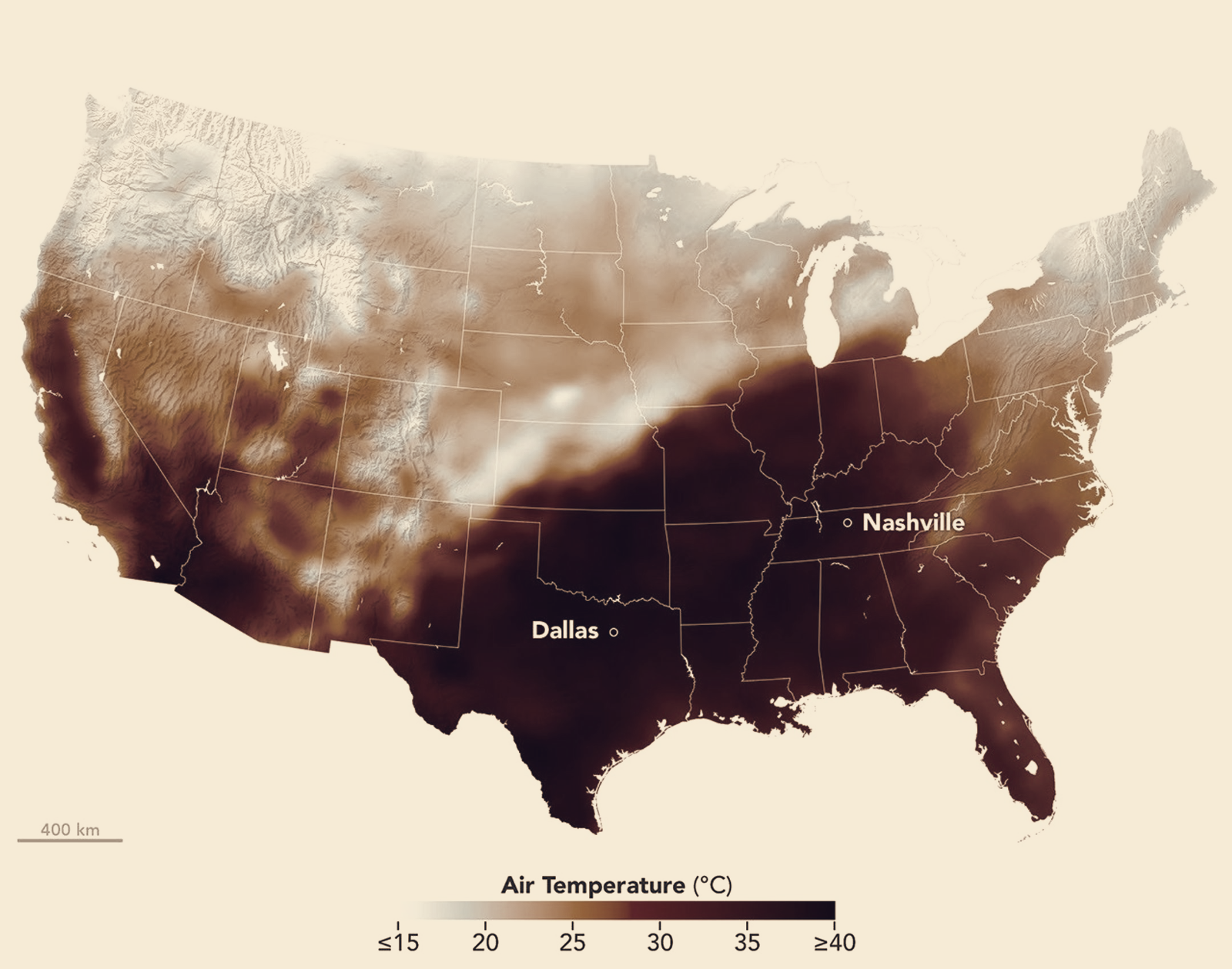
More than 41 million people, roughly 12 percent of the U.S. population, were under extreme-heat advisories, watches, or warnings on September 15 as a heat dome drove temperatures above 40°C across the south-central United States.
Model output from the GEOS system, combining satellite observations with atmospheric modeling, mapped air temperatures on September 15, 2026 at 4 p.m. Central Time, modeled at 2 meters above the ground. The darkest reds on the map correspond to areas where temperatures approached or exceeded 40 degrees Celsius, or about 104 degrees Fahrenheit.
High readings spanned broad portions of Texas, Oklahoma, Arkansas, Missouri, and Tennessee. Several population centres set daily high records that day, including Dallas at 101ºF (38ºC), Memphis at 99ºF (37ºC), and Nashville at 100ºF (38ºC). Nashville’s daytime high broke a record that had stood since 1927, and the city had recorded a record-high minimum temperature of 75ºF (24ºC) the day before.
Meteorologists highlighted that the combination of elevated humidity, limited cloud cover, and light winds would make conditions feel hotter than thermometer readings and increase the likelihood of heat-related illness. The event was driven by an upper-atmosphere ridge, commonly called a heat dome, which pushes warm air toward the surface and traps it, suppressing convection and cloud formation and allowing more solar heating.
The mid-September warmth followed an unusually hot summer: NOAA reported the contiguous United States experienced its warmest June through August in a 132-year record, the 2026 three-month period running 0.4ºF warmer than previous records set in 1936 and 2021. The GEOS map and associated imagery were produced using GEOS-FP data from the Global Modeling and Assimilation Office at NASA Goddard Space Flight Center, and visualised by Michala Garrison.
Meteorologists’ warnings emphasized immediate public-health risk from the heat dome, as the suppressed clouds and light winds could sustain elevated heat stress through the advisory period and raise the potential for heat-related illnesses.