Star-formation theory faces a direct test after NASA’s James Webb Space Telescope detected brown dwarfs with masses as low as twice that of Jupiter in the nearby star-forming region IC 348. The finding, drawn from deep near-infrared imaging and follow-up spectroscopy, pushes the lower mass boundary for objects formed by cloud collapse well below previous expectations and raises questions about how the smallest objects in stellar nurseries form.
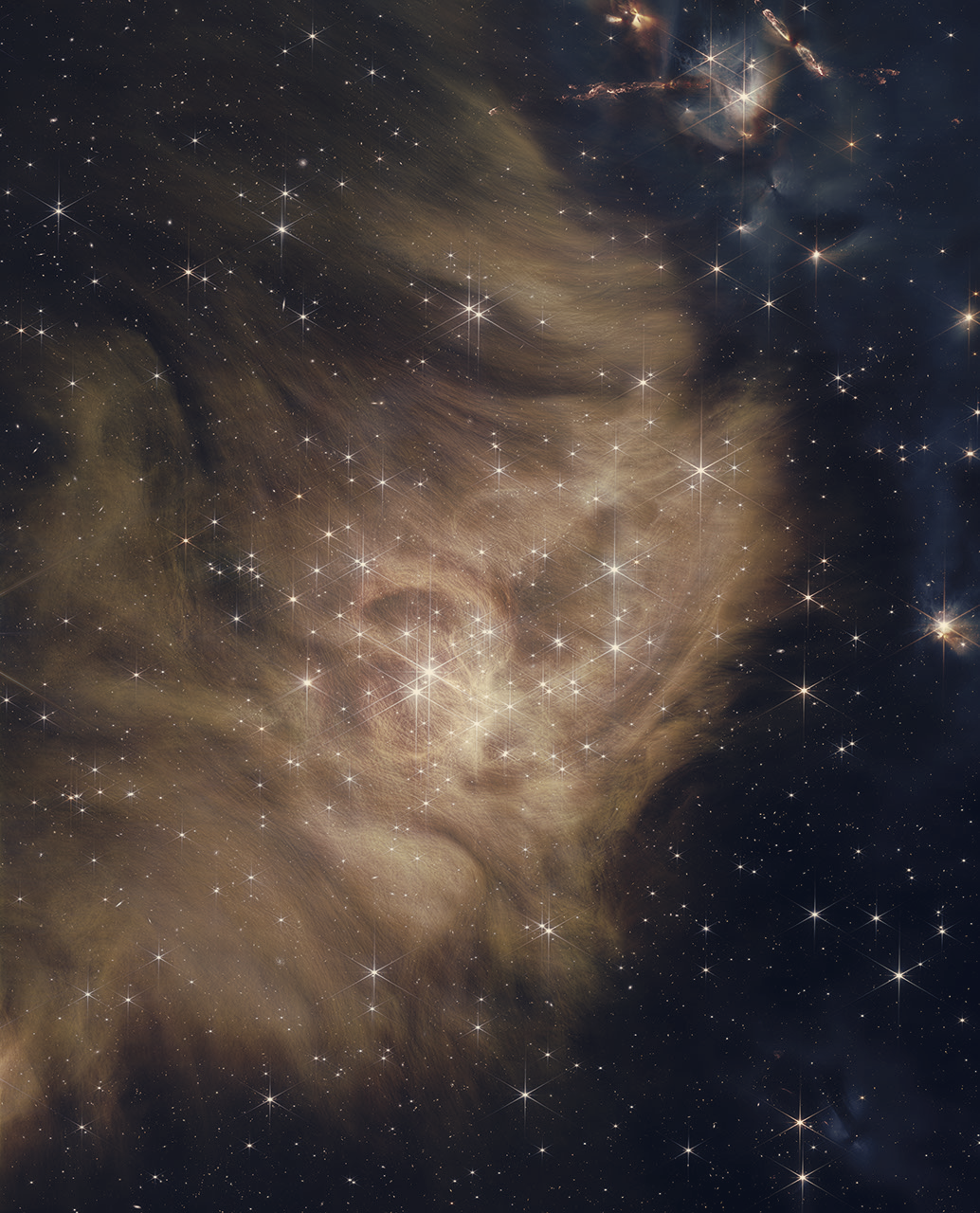
IC 348 lies roughly 1,000 light-years away in the constellation Perseus. Webb’s NIRCam captured a wide, detailed mosaic of the region in 2024 that highlights newborn stars, dense cloud structures and faint substellar objects. Researchers then targeted candidate brown dwarfs from the imaging with Webb’s NIRSpec in 2025 to measure their spectra and estimate masses. Those measurements identified objects with masses down to twice Jupiter’s mass, or 0.19 percent of the Sun’s mass, a range far below where brown dwarfs are normally expected to appear.
Brown dwarfs form when fragments of molecular clouds collapse but fail to ignite sustained hydrogen fusion. The smallest previously reported brown dwarfs in IC 348 measured three to four times Jupiter’s mass in 2022. The new, deeper Webb observations extend that mass range and include the least massive brown dwarfs known. Their existence poses a direct challenge to current models of how fragmentation and accretion set the minimum mass for starlike objects.
The Webb dataset also returned other notable surprises. One of the lightest brown dwarfs shows evidence of a surrounding disk, implying that planet-building material can exist around an object whose mass rivals that of a planet. Spectra of the faintest brown dwarfs revealed a distinct absorption feature attributed to an unidentified hydrocarbon, a trait previously seen only in the atmospheres of the lowest-mass brown dwarfs and potentially indicative of a separate spectral class.
The image contains more than substellar oddities. Webb resolves a compact cluster of protostars in the field’s upper right, several accompanied by Herbig-Haro objects where jets from growing stars slam into nearby gas and dust. The horizontally oriented Herbig-Haro structure HH 797 breaks into two protostars with nearly parallel outflows, while the propeller-shaped HH 211 shows both narrow jets and broader streams.
Taken together, the observations show Webb’s capacity to probe fainter and lower-mass members of star-forming regions than before, and they force a rethink of the lower limits of the star-formation process. Researchers will need to revise theoretical models or identify additional formation pathways to explain how objects at these masses can form and retain disks and atmospheric chemistry like those observed with Webb.