
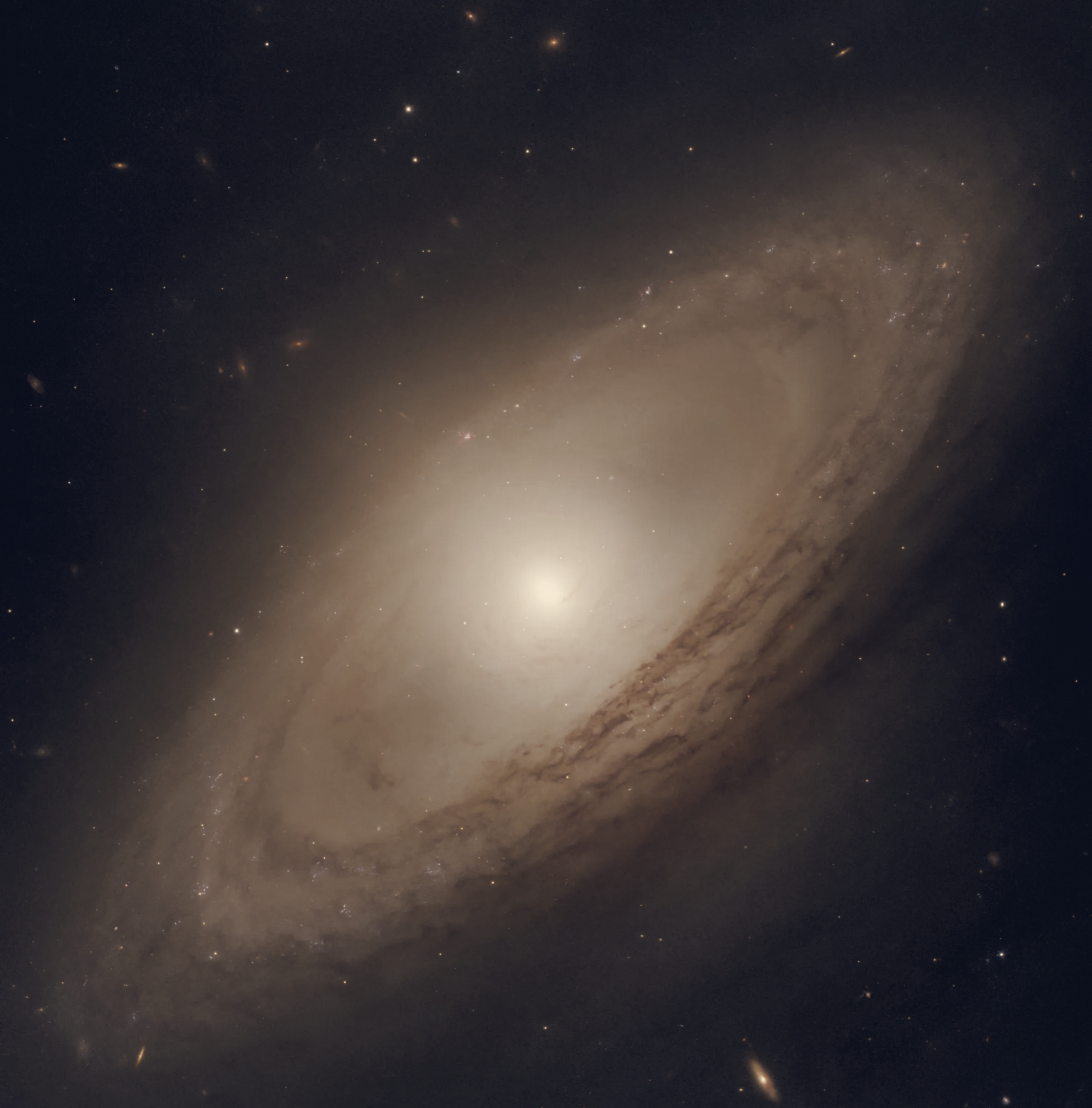
The photograph shows delicate arms curling around a thin stellar disk, but those arms are most pronounced at the galaxy’s edge. Brown, opaque dust lanes thread the outer structure, and the arms are peppered with small groupings of bright blue stars. Those blue clumps mark compact pockets of young, hot stars set well away from the glowing central region.
Where many spirals display continuous arm structure that reaches or spirals into the nucleus, NGC 4698 presents a ring-like arrangement. The arms appear to skirt the central light rather than wind down to it, leaving the inner zone comparatively free of the sweeping arm features seen farther out.
The image credits and team behind the release are listed as ESA/Hubble & NASA, D. Thilker, the MAUVE-HST Team. The combination of visible dust lanes and concentrated young star groups in the outer disk offers a clear visual example of how spiral morphology can vary among galaxies classified as similar to the Milky Way.
Observers and researchers now have a detailed frame showing a spiral that emphasizes its outskirts, a pattern that will serve as a point of comparison for studies of arm formation, dust distribution, and star formation across different galactic environments. The image was released Sept. 18, 2026 and is credited to ESA/Hubble & NASA, D. Thilker, the MAUVE-HST Team.