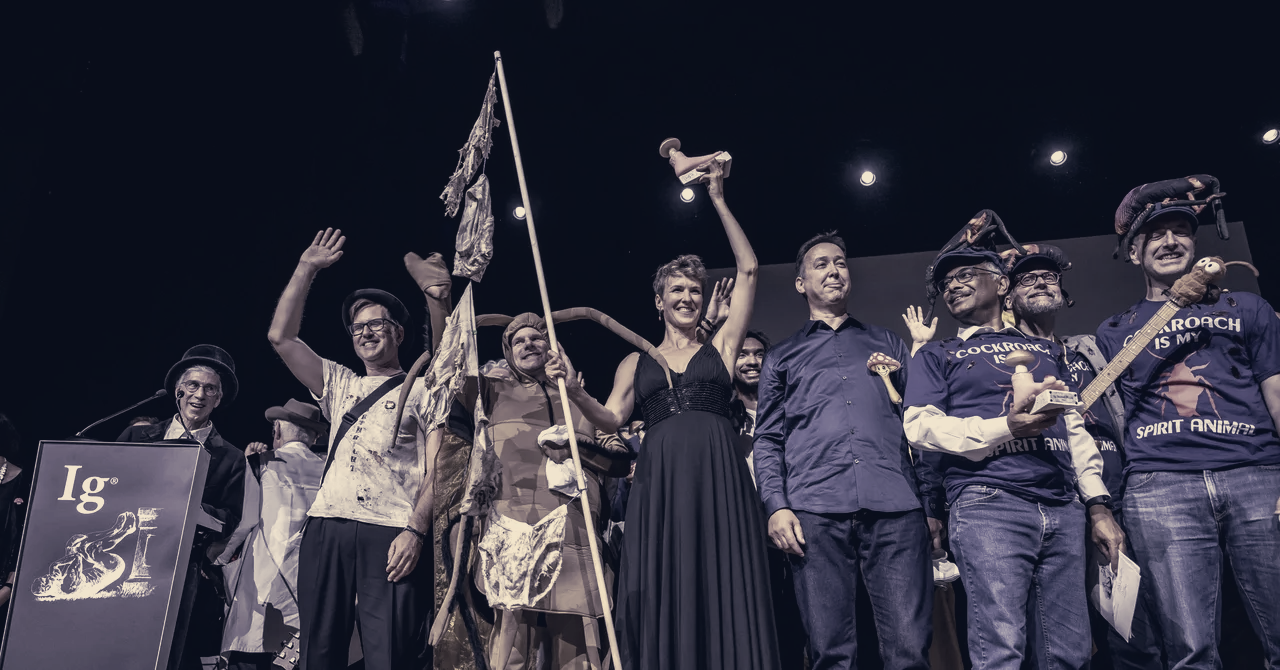

The Ig Nobel Prizes shifted attention this year toward research that pairs absurd setups with usable findings, awarding 10 projects in Zurich that ranged from cockroach milk chemistry to using mosquito mouthparts as 3D printer nozzles. The awards, run by Improbable Research since 1991, celebrate studies that first provoke laughter and then prompt serious questions.
A biomechanics prize went to a team that produced a cross-species scientific definition of a kiss, categorizing it as a non-agonistic oral-oral interaction involving movement of lips or oral structures and no food transfer. Under that definition, great apes, dogs, cats, pigeons, penguins, squirrels, black bears and tortoises all qualify as kissers, though the social meaning of those contacts varies.
The economics prize went to research published in PNAS titled "Higher Social Class Predicts Increased Unethical Behavior." Across seven experiments, the authors linked higher socioeconomic status to a greater tendency to prioritise self-interest, observing behaviors such as breaking traffic rules, failing to yield, cheating, and taking candy from children.
Chemistry honours recognised work on the nutrient-dense crystals formed inside embryos of the cockroach Diploptera punctata. The team analysed how those crystals concentrate proteins, fats and sugars into a compact form, a line of inquiry that frames insect-derived substances as possible models for dense nutritional delivery.
The medicine prize was awarded posthumously to Unno Tokuji for his study of nose-blowing technique. His analysis of nasal aerodynamics and pressure on the ears led to a practical recommendation: when one nostril is more congested, blow it one at a time using a long, relatively forceful exhalation rather than short, weak blows.
Biologists testing defensive biting in the South American pit viper Bothrops jararaca applied calibrated pressure to different body regions under controlled conditions. Stepping on the head produced a 44 percent probability of a bite, pressure on the body yielded a 20 percent probability, and pressure at the tail showed an 11 percent probability.
Physics researchers modelled how stream angle affects splashing at urinals and concluded lower impact angles significantly reduce droplet bounce. The team built prototypes around that principle with an eye toward cleaner public restrooms. In technology, investigators repurposed the mosquito proboscis, noting that its ultrathin, evolution-shaped tube functions like an ideal nozzle for fine-scale 3D printing.
An olfaction prize confirmed that parents rated the body odor of young children more favourably than that of teenagers, a finding the researchers suggest may reflect an underappreciated channel of family communication and recognition. A peace-themed project used questionnaires about desired friend behaviour toward the self, strangers and enemies; the published summary in the awards material describes the study design but the presentation of its conclusions was incomplete in the available report.
Improbable Research continues to use the annual ceremony to highlight experiments that blend whimsy with methodological rigor, keeping the spotlight on odd questions that can yield concrete insights across design, nutrition, medicine and social science.