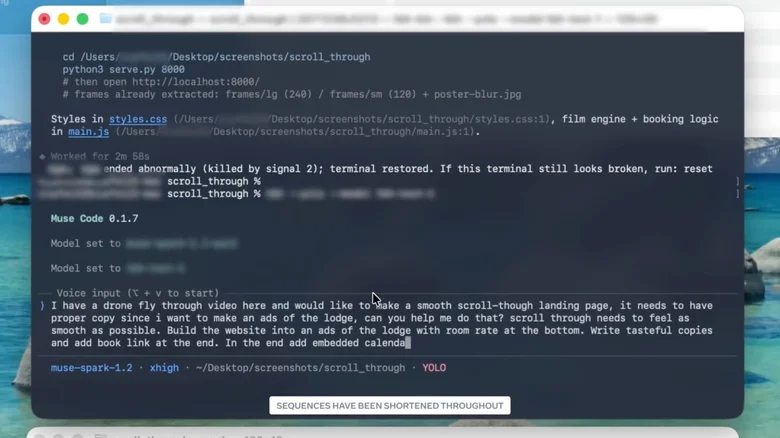
Companies relying on coding agents for software engineering tasks may soon face a significant shift in the market, as Meta introduces Muse Code, a terminal-based coding tool powered by a new AI model, Muse Spark 1.2. This move is likely to affect businesses that currently use Anthropic's Claude Code and OpenAI's Codex, as Muse Code offers similar capabilities, including writing code, planning changes, and validating results. With Muse Code, developers can build working software using text prompts, and the tool can also manage multiple sub-agents to complete tasks more efficiently.
Meta's announcement highlights the tool's potential, with sample projects such as an interactive model of a photon sphere and a Plants vs. Zombies knockoff, as well as a demo video showcasing the tool's ability to build a webpage based on an MP4 file. The company is positioning Muse Code as a more affordable alternative to its competitors, with a pay-as-you-go pricing model that starts at $1.25 per million input tokens and $4.25 per million output tokens. Additionally, Meta is offering a contributor tier, which requires users to provide feedback to improve the coding agent, at a significantly lower cost of $0.10 per million input tokens and $0.20 per million output tokens.
This pricing strategy may prove attractive to companies looking to reduce their costs, particularly in comparison to Anthropic's Sonnet 5 model, which costs $3 per million input tokens and $15 per million output tokens. According to Alexander Wang, Meta's Chief AI Officer, the company's goal is to make Muse Code an accessible option for developers, and the contributor tier is designed to encourage user feedback and improvement. As the market for coding agents continues to evolve, Meta's Muse Code may become a viable alternative for businesses seeking a more affordable and efficient solution.
The potential impact of Muse Code on the market is significant, as companies may begin to switch to Meta's tool to avoid the growing costs associated with US AI tools. This trend has already been observed in the Chinese market, where companies have opted for Chinese AI models like DeepSeek to reduce their expenses. As Meta's Muse Code becomes more widely available, it will be important to monitor its adoption and the subsequent effects on the coding agent market.