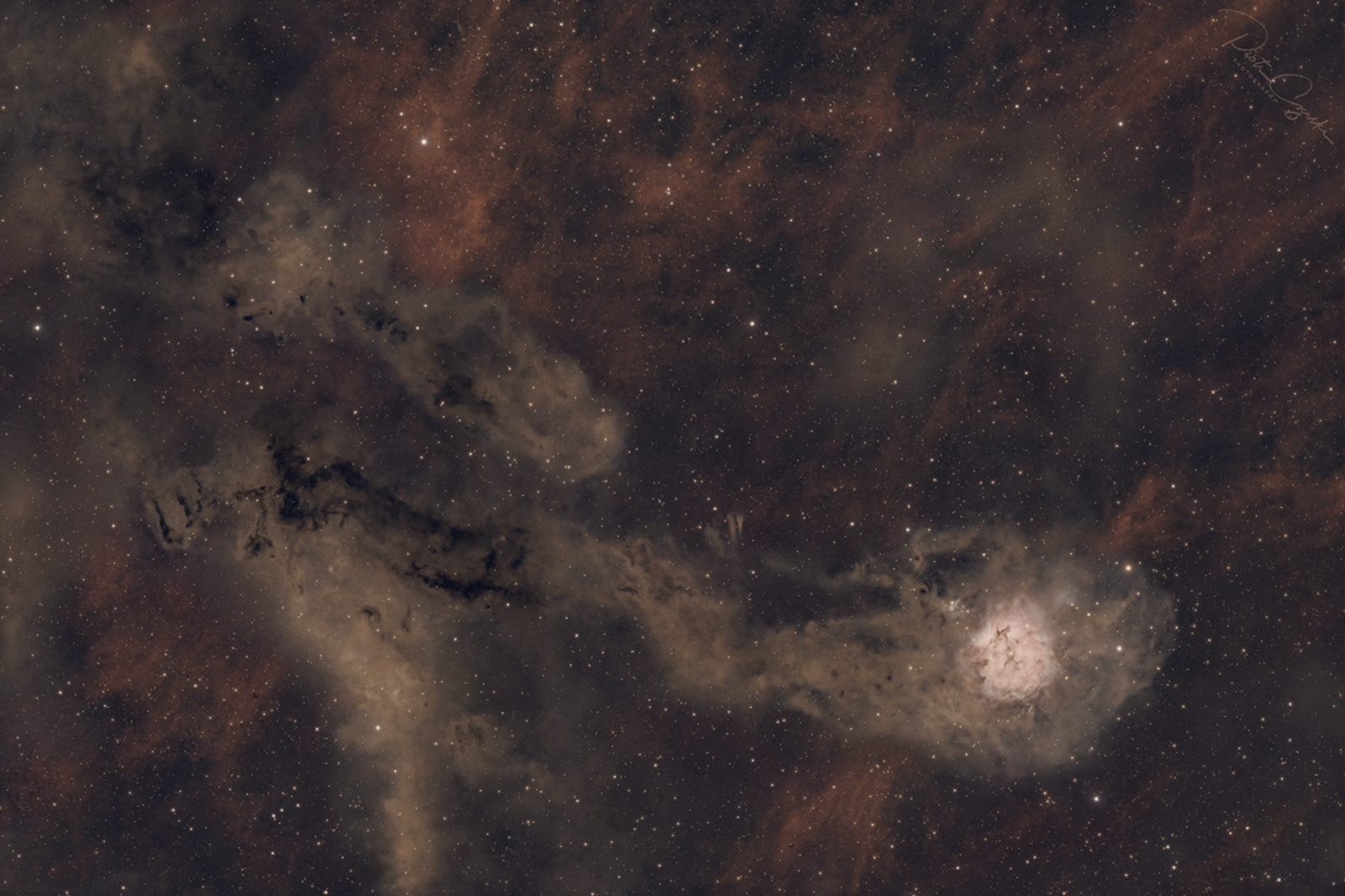
A wide-field photograph ties the Cocoon Nebula’s compact bright head to an extended dark tail, showing the star-forming complex IC 5146 as a head roughly 10 light years across followed by nearly 100 light years of dusty filament. The scene sits in the high-flying constellation of the Swan, Cygnus, and lies about 2,500 light years from Earth. The overall silhouette makes the nebular complex resemble a comet, with emission and reflection concentrated around the bright head and long lanes of obscuring dust trailing to the left.
A bright star close to the nebula’s centre is the likely energy source for the glowing gas and has probably helped carve out a cavity within the head. Although the long filaments in the tail appear dark in visible light, they conceal stars in the process of formation. Those forming stars are not visible in the pictured wavelengths, but their presence is indicated by the dusty structures.
The photograph was taken in July from Death Valley, California, USA, and is credited to Piotr Czerski. The image and short explanation were assembled by the Astronomy Picture of the Day editors: Robert Nemiroff, Jerry Bonnell, Cecilia Chirenti and Keighley Rockcliffe. The APOD service is provided by the Astrophysics Science Division at NASA’s Goddard Space Flight Center, NASA Science Activation, and Michigan Tech University.
Practical changes for readers include a URL update: APOD’s main NASA page is moving from apod.nasa.gov to science.nasa.gov/apod. The site lists the next featured picture as a triple eclipse.