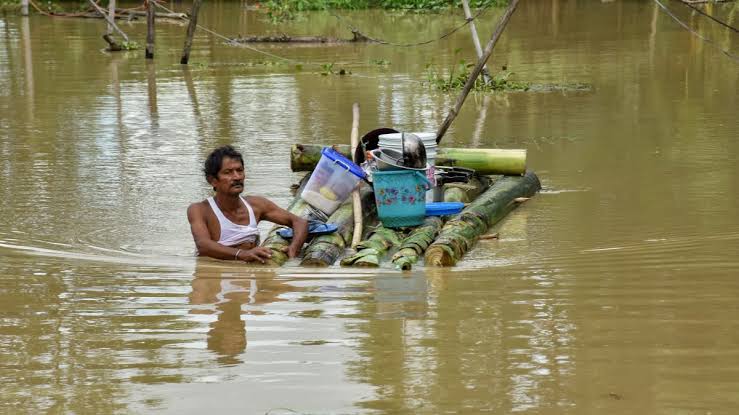
At least 1.2 million people have been affected by the floods in Assam, with 100 deaths reported and25 districts impacted. The floods have damaged over 19,000 houses and left more than 75,000 people in 252 relief camps. In the Sivasagar district, one of the worst-affected areas, a 97-year-old woman, Lokada Duarah, was rescued by her family on a makeshift raft made of banana trunks. Her family had to act quickly, as the floodwaters were rising rapidly, and they had no other means of escape.
The floods in Assam have been particularly severe in parts of Upper Assam, where villages that do not usually flood have been inundated. Bornali Baruah, a resident of Charing village in Sivasagar district, said that this was the first flood she had experienced in her lifetime. Her home, which is about 25km from Sivasagar town, was flooded, and she lost most of her livestock, including goats, ducks, and chickens. The flood also destroyed her farm equipment and furniture.
The Brahmaputra river, which runs through Assam, is one of the largest multi-channel rivers in the world, and its flooding is a natural phenomenon. However, the frequency, intensity, and severity of the floods have increased in recent years, according to Dhrubajyoti Sahariah, a professor of geography at Gauhati University. Sahariah attributes this to the increased sediment load in the river, which comes from Tibet, where the river originates. The sediment load has been exacerbated by human activities such as deforestation, mining, and hill-cutting, which have increased the amount of sediment in the river.
The Assam government has set up 52 relief camps to provide shelter and food to the affected people. The government has also provided relief kits containing rice, lentils, and cooking oil to the families. However, the relief efforts have been hindered by the lack of electricity and mobile connectivity in some areas. The floods have also highlighted the need for better flood-control measures in the region, which cannot be managed by Assam alone, as many of the tributaries of the Brahmaputra river originate in surrounding hill states.
The floods in Assam have caused widespread destruction and displacement, and the situation is likely to worsen in the coming days. The Indian government has announced plans to provide assistance to the affected people, but more needs to be done to prevent such disasters in the future. The floods have also raised questions about the region's hydrology and the need for better infrastructure planning to mitigate the effects of flooding.