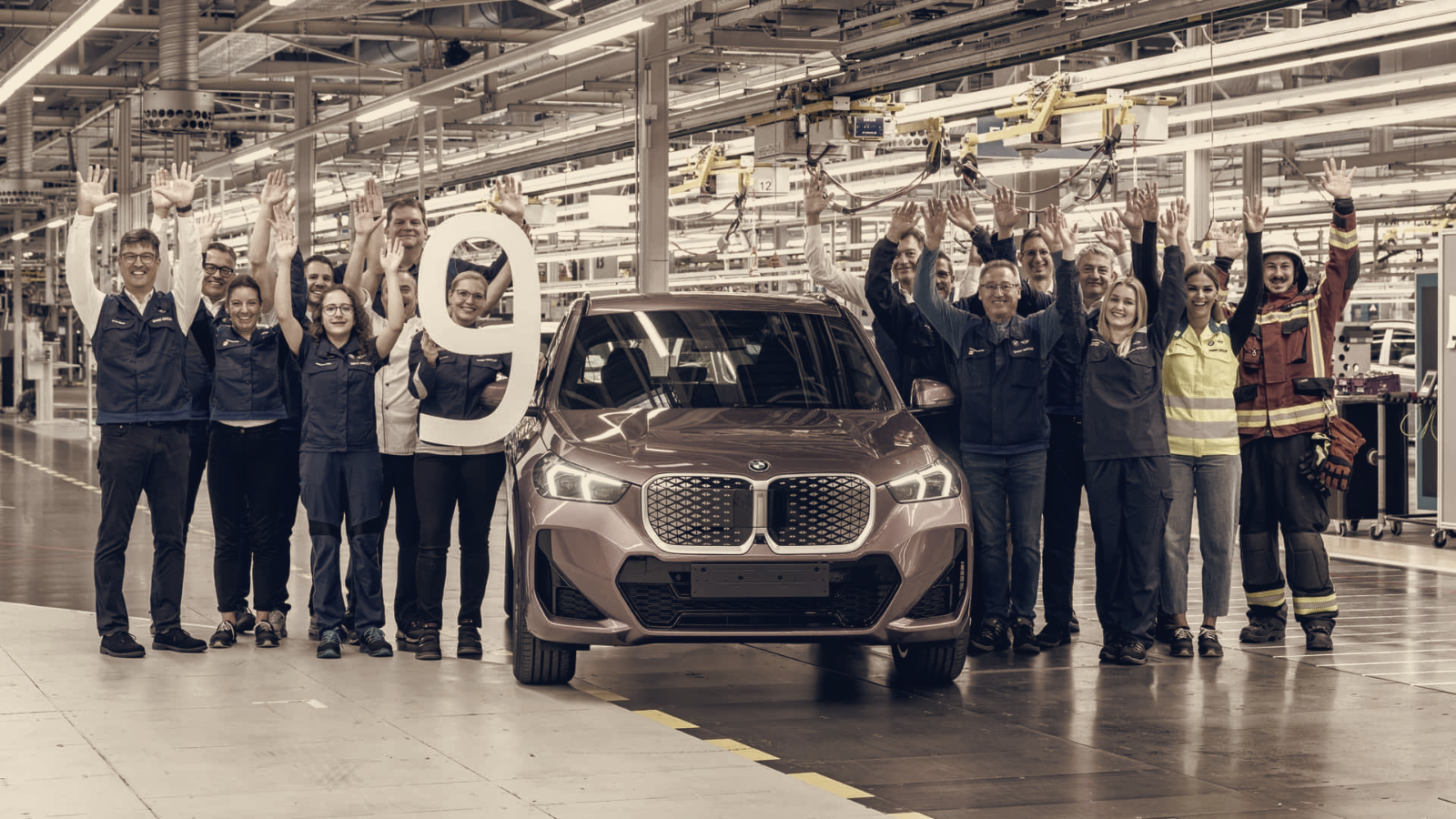
BMW gains a flexible production tool after its Regensburg factory built its 9,000,000th vehicle, a Velvet Orchid II Metallic iX1 made to a Swedish customer’s specification. The milestone, timed in the plant’s 40th year, highlights Regensburg’s ability to switch between gasoline, plug-in hybrid and fully electric powertrains on a single assembly line, letting BMW raise electrified output without opening a dedicated EV plant.
Regensburg began assembly work in 1986 with the E30 3 Series under an agreement that called for 400 cars a day and 3,500 jobs. By 2025 the factory was operating three shifts and BMW said a new vehicle was completed about every 57 seconds. That pace made Regensburg BMW’s highest-volume European plant that year, with roughly 356,000 vehicles shipped worldwide in 2025.
Today the site and the nearby Wackersdorf operation employ around 9,000 people. The line’s current output concentrates on X1 and X2 crossovers. BMW ran gasoline, plug-in hybrid and battery-electric versions on the same assembly sequence, a setup that allowed Regensburg to produce more than 150,000 electrified vehicles in 2025 without reducing combustion-car output.
BMW frames the orchid-colored iX1 as symbolic. The Velvet Orchid II Metallic finish comes from the BMW Individual paint program, which equips cars to a buyer’s bespoke specification rather than drawing from dealer stock. That single-car detail underlines the plant’s capacity to accommodate custom orders while keeping overall throughput steady.
Regensburg passed 8.7 million vehicles built by the end of 2025 and reached the 9,000,000 mark in September 2026. For BMW, the immediate implication is operational flexibility: the factory can act as a pressure valve if customer demand shifts further toward electric crossovers, letting the company dial EV volume up or down on an existing line rather than waiting for new capacity to come online.
What happens next will depend on buyer demand and BMW’s wider platform strategy. If the market continues moving toward electric-first architecture, Regensburg’s mixed-powertrain production model gives BMW a ready means to increase EV output quickly while preserving the option to continue building internal-combustion models at scale.